
Certify every credit decision,
before the money moves.
Reliax is the reliability layer for AI in high-stakes decisions. We start where silent failure costs the most: credit. Every decision gets a coverage certificate that holds per segment, a calibrated risk bracket, a two-verdict drift tripwire and a signed record, and is routed to allow, review or block on the certified quantities only, under a policy you own. One API call. Zero retraining.
routed on set size · bracket width · drift · credibility, under policy v4 · BLOCK = a human decides
the theorem, verified on public credit data
certified REVIEW at 54% referral · 8.0 ms median per decision
vs 0.14 for the raw model · predicted before the outcomes
disbelief claimed vs realised after a real payment-delay shift
Measured on two public UCI credit datasets, 31,000 applicants, in our working paper and its public evaluation repo. The REVIEW catch equals a confidence cut at that rate, with a guarantee attached. No customer data yet. See where we are.
Credit models fail three ways. All of them silently.
01 / problemThe consequential action, approving the loan, happens at inference time, long before any dashboard, quarterly validation, or delinquency report notices.
Confidently wrong
A wrong approval looks exactly like a right one: same score format, same confidence. The loss surfaces 12+ months later, as P&L.
Calibrated for a dead economy
A rate shock shifts the applicant pool in weeks; regulated retraining takes quarters. Nothing in the score says "my calibration era is over".
Fair on average, unfair per segment
Aggregate accuracy can hide that one segment (young or thin-file applicants) gets systematically less reliable decisions. Average metrics never show it.
From 20 Nov 2026 the Consumer Credit Directive recast gives every applicant a right to human intervention and a meaningful explanation on an automated creditworthiness decision (Art. 18(8)). From 2 Dec 2027 creditworthiness assessment is high-risk under the EU AI Act (Annex III 5(b)): Art. 12 logging and Art. 72 post-market monitoring, per Regulation (EU) 2026/1744. SR 11-7 applies today. None of the AI Act duties is lending-specific: Art. 26 puts oversight, log retention and monitoring on the deployer of any Annex III system, and Annex III also names employment (4(a)), essential services (5(a)) and life or health insurance pricing (5(c)). Credit is where the clock runs first.
One application's journey, from click to defensible decision.
02 / how it worksThis is what your decision flow sees when Reliax sits behind it. Your model stays untouched; Reliax reads the same application and your model's output, builds the envelope, and routes on the certified quantities only. The replay loops through three situations. Click any step, or any line of the envelope, to open the technology behind it and watch it work on that applicant.
Illustrative replay of the pipeline implemented in demo v3, with the applicant numbers chosen to show each situation. Observe mode adds 0 ms to your decision path; gate mode holds the decision for the envelope (8.0 ms median in the whitepaper). auto-replays until you open a step
The existing stack answers the wrong question.
03 / landscape| Layer | Question answered | Why it falls short for credit |
|---|---|---|
| Model monitoring | "How is the model doing in aggregate?" | Sees drift after the bad vintage is booked. No per-application signal. |
| Explainability | "Why did the model say this?" | Reason codes are mandatory, but an explained wrong answer is still a wrong answer. |
| MRM / governance platforms | "Is the model documented and validated?" | Workflow and documentation around the model. Nothing runs in the decision path. |
| Decision engines | "Which rule fires for this applicant?" | Execute ALLOW, REVIEW and BLOCK on business rules. The prediction arrives with no warrant attached. |
| Conformal libraries | "What is a valid prediction set?" | Offline, one model, coverage over a batch. No drift tripwire, no policy, no signed record, no chain. |
| Reliax | "What was guaranteed here, and should it be auto-acted on?" | A certificate in the decision path, a drift tripwire, a policy and a signed record. Plugs into the decision engine; exports evidence to the MRM platform. |
"What was guaranteed about this decision, and should it be auto-acted on?"
Per application, at decision time, with evidence a model-validation team and a regulator can replay.
One API call. Every output gets a trust envelope.
04 / the reliability envelopeEvery application comes back with a full envelope, and routing reads the certified quantities only. The schema below is the target the demo is being aligned to; field values are illustrative.
{ "input": <application>, "output": <prediction>,
  "segment": { "age_band": "30-49" } }      // business segment

→ 200 OK
{ "certificate": {
    "prediction_set":  ["repay"],
    "coverage":        "≥ 0.95 · cohort C · segment 30-49",
    "guarantee":       "active",
    "guarantee_scope": "stage" },
  "risk_interval":  [0.02, 0.05],           // Venn-Abers
  "credibility":    0.61,                   // exchangeability p-value
  "calibration":    { "d": 0.02, "cell_n": 412,
                      "insufficient_evidence": false },
  "drift":          { "inputs": "OK",
                      "outcomes": "OK · as of 2026-08-31" },
  "routing":        "ALLOW",                // policy v4
  "triage_rank":    84,                     // advisory
  "attribution":    { "diagnostic": true, ... },
  "audit_id":       "rxe_7f3a9b..." }
Coverage certificate
A prediction set from a procedure that contains the true outcome at least 95% of the time, marginally and on every declared segment (Mondrian). Plus a credibility p-value: is this input exchangeable with the calibration data?
Risk bracket + calibration opinion
A Venn–Abers bracket [p₀, p₁] at this score level, and a calibration opinion per segment and score bin on how far the stated probability can be trusted, with an error bar and a thin-cell flag. Never a probability that this applicant repays.
Drift, two verdicts
A live, anytime-valid verdict on inputs and scores, and a delayed outcome verdict updated as labels or delinquency proxies land. On alarm the guarantee is suspended for the segment; the pipeline is never paused.
Routing + signed record
ALLOW · REVIEW · BLOCK on set size, bracket width, drift and credibility under a named policy version. BLOCK means a human decides, never decline. Each record, certificate text included, hashes the previous one; you own the trail.
{ "certificate": {
    "prediction_set":  ["standard"],
    "coverage":        "≥ 0.95 · cohort C-uw · segment 40-49 non-smoker",
    "guarantee":       "active",
    "guarantee_scope": "stage" },
  "risk_interval":  [0.41, 0.52],           // loss outcomes
  "drift":          { "inputs": "OK",
                      "outcomes": "pending · claims lag" },
  "routing":        "ALLOW",                // policy uw-v2
"audit_id": "uwx_4b12c7..." }The envelope is not a credit object
Field for field, the insurance certificate is the credit certificate. The prediction set, the coverage statement, the calibrated bracket, the two drift verdicts and the signed record are the guarantee layer, and they are true of any scored decision. What changed is the policy layer: the cohort, the segment, the evidence source behind the bracket, and the policy name the routing cites.
Illustrative field values. Our published evaluation covers credit only; see the evidence section.
A few thousand of your own past decisions with outcomes, or none to start: drift, credibility and the audit record are label-free and run from day one. Calibration lands when outcomes exist, starting on the domain's leading indicator: in credit, 30/60/90-day delinquency proxies, re-certified as defaults land. Shadow-mode replay first. REST · Python SDK · cloud, VPC or on-prem.
Three theorems. Two signals. A bright line between them.
05 / method and its limitsEverything in the envelope is labelled either proven or signal, and routing runs on the proven part only. Blur that line and the whole product is marketing.
- ✓Marginal coverage: P(Y ∈ Ĉ(X)) ≥ 1−αSplit conformal; distribution-free, finite-sample (Vovk et al. 2005).
- ✓Per-segment coverage: P(Y ∈ Ĉ(X) | G=g) ≥ 1−αMondrian conformal, one calibration per declared segment. Per-applicant coverage is provably unattainable distribution-free, for anyone (Vovk 2012; Barber et al. 2021).
- ✓Credibility per decision: P(credibility ≤ t) ≤ tThe conformal p-value of the input: a valid test that it is exchangeable with the calibration data.
- ✓Calibrated PD bracket [p₀, p₁]Venn–Abers: one of the two calibrators is perfectly calibrated (Vovk & Petej 2014).
- ✓Drift alarm at controlled error: P(false alarm, ever) ≤ 1%Conformal test martingale + Ville's inequality; anytime-valid, per stream over the whole run, and the budget multiplies across models and segments.
- ✓Tamper-evidenceSHA-256 hash chain; any edit to any historical record breaks verification.
- △The triage rank, 0–100Built from credibility, confidence, bracket width, calibration opinion and drift state. Advisory, never in a routing rule, never printed as a percentage. In a stable population it trails the model's own confidence; its OOD-gated form beats confidence while a shift is in progress (exploratory). A pre-registered test decides whether it ships.
- △The calibration opinion and chain attributionPer segment and score bin, from the FUSION 2025 method adapted to credit: proven to equal the binned calibration error with its sample size attached, with a finite-sample error bar and a thin-cell flag. Says where the stated probabilities are wrong, not who will default. In a chain, the same calculus says where the unreliability entered. Diagnostic.
- △OOD distance & PSI drift tablekNN distance and Population Stability Index: warning signals in the validator's own vocabulary. The distance is what catches a corrupted feed.
- △Adverse-impact watchRolling four-fifths ratio on approval rates: a screening heuristic, not a legal determination.
Conformal + Mondrian
The certificate. Prediction sets with guaranteed coverage, marginally and per audited segment.
Venn–Abers
The credit dialect. Two isotonic calibrations bracket the true PD; the interval width prices the uncertainty.
Test martingale
The validity switch. Bets against the uniformity of conformal p-values; wealth ≥ 100 rejects exchangeability at 1%.
Fair on average is not fair. We audit coverage per segment.
06 / coverage parityIn our demo portfolio the model never sees age, yet marginal conformal quietly under-covers young applicants at ~92% against a 95% target, because bias flows through correlated features. Exactly like real portfolios. This is coverage parity per segment, not a statement about outcome fairness.
Audit: find the gap
Held-out per-segment coverage audit: marginal q̂ vs the 1−α target, for every audited segment. The gap is measured, not assumed.
Repair: Mondrian calibration
One conformal calibration per segment restores the guarantee group-by-group. When a request carries the segment, the group-conditional certificate governs routing.
Watch: live adverse impact
Rolling approval rates per segment and the four-fifths ratio, on the same monitor as drift. Labelled a screening signal, because that's what it is.
| segment | marginal | Mondrian |
|---|---|---|
| 18–29 | 0.922 | 0.934 |
| 30–49 | 0.942 | 0.943 |
| 50+ | 0.953 | 0.942 |
Segments used at inference are the business segments your model risk team records in the policy (product, channel, thin-file flag, score band). Protected classes are never conditioned on at inference (Reg B §1002.5, §1002.6); parity by protected class is an offline audit with proxies under the §1002.15 self-test, and Regulation (EU) 2026/1744 gives EU providers a legal basis to process special-category data for bias detection. The audit also reports the REVIEW rate by proxy group, so thin-file routing cannot quietly become a disparate-impact problem.
Watch a rate shock break a model's certificate.
07 / drift, animatedAn animated replay of what demo v3 computes live: a stable book, then a macro shock the model was never calibrated on. The martingale's wealth is the evidence; crossing 100 rejects exchangeability at the 1% level, and every envelope flips invalid.
log₁₀ martingale wealth · WATCH at 20 · ALARM at 100 (Ville: ≤1% false alarm, ever)
Illustrative animation of a computed phenomenon; in the live demo the same curve is produced by real streamed applications. This is the live verdict on inputs and scores; a macro cycle shows up in outcomes months later, which is why the certificate carries a second, delayed verdict (see how it works, drift tab). auto-replays
Measured on credit. The theorems are not.
08 / evidenceA working paper evaluates every envelope component on UCI Taiwan default (30,000 applicants, 2005) and German credit (1,000, 1994): the datasets credit people know, reproducible evidence rather than proof on your book. Every number below is measured, mean ± std over seeds, reproducible from public code and data.
Domain-agnostic, true of any scored decision: conformal coverage, the Venn-Abers bracket, the exchangeability martingale, the signed record. Credit-tuned, the policy layer: delinquency proxies as the interim label, scorecard order of operations, Reg B reason codes, IFRS 9 cohort statements. Credit only, today: every number below.
± 0.0040 on Taiwan · 0.9532 ± 0.0167 on German. The theorem, verified on real applicants.
on 5 × 600 i.i.d. real applications; a real subpopulation shift is caught in 4/5 streams.
vs 0.083 T-scaled and 0.186 raw on a miscalibrated model. Never worse when the model is already calibrated.
p95 17.5 ms, full stack, 7,500 calibration rows. The 1M-row figure is the next measurement.
raw vs Venn-Abers stage, realised on unseen applicants; the opinion predicted 0.125 and 0.051 beforehand.
disbelief claimed on reference data vs realised after the shift: why the certificate carries a delayed outcome verdict.
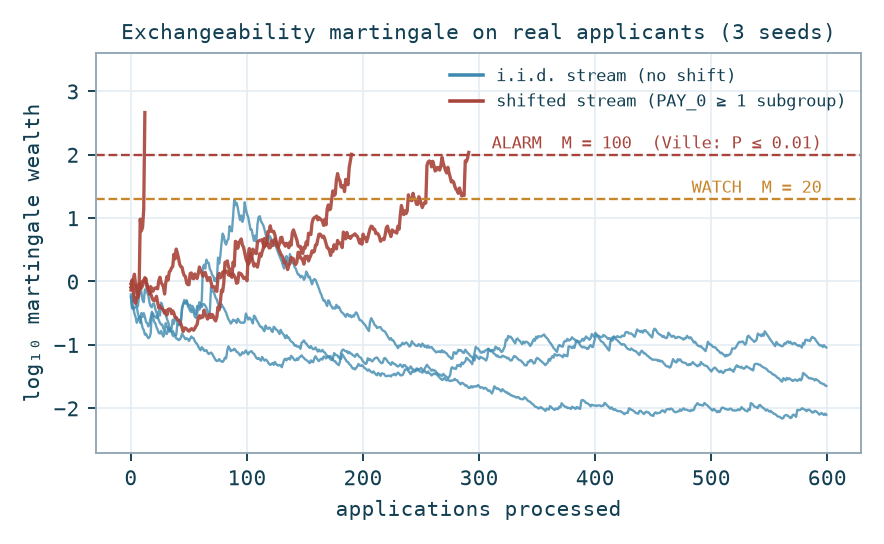
from the paper Exchangeability martingale on real applicants: i.i.d. streams stay below the thresholds; streams drawn from the real delayed-payment subpopulation accumulate evidence and cross ALARM.
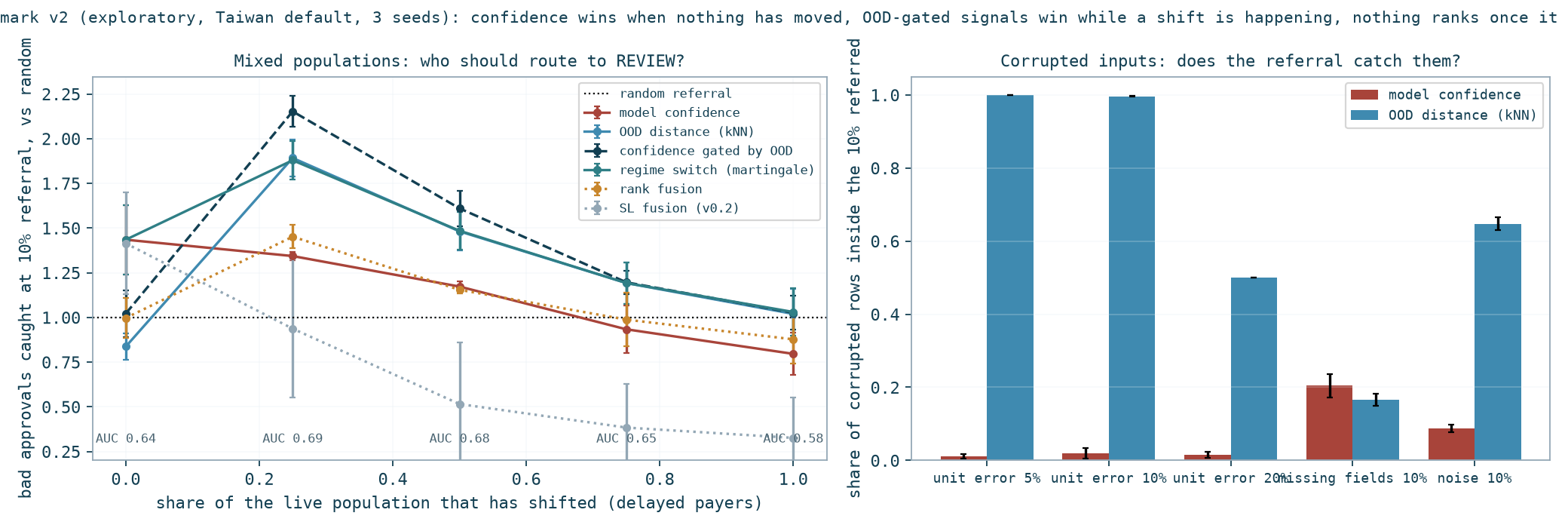
exploratory · Taiwan · 3 seeds Three regimes, one routing question. Confidence wins when nothing has moved; confidence gated by the OOD distance catches 2.2× random and 1.6× confidence with a quarter of the book shifted; nothing ranks once the shift is complete, where the tripwire fires in every seed. A currency bug on monetary fields is caught 100% by distance and 1% by confidence.
- ✓The calibration opinion holds out of sampleClaimed vs realised disbelief within 0.003 on Taiwan and 0.02 on German; its finite-sample envelope held in 500 of 500 trials; five propositions with proofs in the repo.
- ✓Certified routing cuts bad approvals 138 → 41 per 1,000At a 54% REVIEW rate, α = 0.05. The same catch as a confidence cut at that rate: the value is the guarantee on the threshold, and the REVIEW rate rising on its own under shift.
- ✓Corrupted inputs are caught by distance, not confidenceUnit error on monetary fields: 100% of affected rows inside the 10% referred, vs 1% for confidence. Zeroed fields are caught by neither; that needs a schema check.
In a stable population no signal, ours included, ranks mistakes better than the model's own confidence. On the severe shifted split the pre-registered bar is not met and our v1 ranking fell below random referral; the ranking stays advisory. The moderate regime meets the bar on exploratory data only, and the pre-registration amendment adds it before the confirmatory datasets are opened.
Peer-reviewed, patented, running. Not yet sold.
09 / where we are · September 2026Conformal + Mondrian + Venn–Abers + calibration opinion + martingale + PSI + coverage-parity audit + audit chain: every number computed live.
Six peer-reviewed papers on uncertainty and trust; one granted US patent.
Design-partner pilots on lenders' historical books are the immediate milestone.
- ✓Demo v3: the credit reliability consoleLive certificates, drift injection, coverage-parity audit, tamper-evident log. Routing is being moved onto certified quantities only.
- ✓Method published, calibration stage implementedThe FUSION 2025 calibration-trust method is now code, tests and five proven propositions; PaTAS (arXiv:2511.20586) is the chain-attribution calculus.
- ✓Evaluated on public credit dataCoverage at target, zero drift false alarms, 8 ms median envelope, held-out calibration opinions, and a three-regime shift benchmark.
- ✓Credit-first strategy lockedClinical and insurance deferred; the wedge is regulated lending.
- ✗No pilots or customer data yetEvaluation covers public datasets; lender shadow-mode replays are the next milestone.
- ✗Ranking under shift: exploratory onlyThe severe split failed the pre-registered bar; the moderate regime passes it on Taiwan only. The amendment is drafted; Give Me Some Credit and Home Credit are untouched.
- ✗No SOC 2 · outcome verdict and chain certificates in buildAll scoped for the production build.
One built the method. One knows the room it's sold in.
10 / teamIsmael Ouattara
Co-founder · CEOHis doctoral thesis is the product.- PhD, Information Technology (2026)Ulm University · Huawei Munich; PaTAS is the thesis framework
- École Polytechnique · Télécom ParisEngineering and ML, security track
- Mithril Security · Nokia Bell LabsML security research; where the patent comes from
- Six peer-reviewed papers · one US patentFUSION, ECML-PKDD, ICICS, RuleML+RR, IEEE VCC
Sébastien Michel
Co-founder · CFO & BusinessSpeaks the buyer's language.- London Business School · UCL · Sciences PoMSc Financial Analysis · BSc Economics and Data Science
- Klesch Group · Lansdowne PartnersM&A, risk & analytics; private and growth equity
- Zadig · Stifel FinancialPublic-market investing and equity research
- Runs finance, fundraising and pilot sourcingFrom inside the functions the buyer reports into
Full list on request. Also: FUSION 2024 (subjective-logic trust discount), RuleML+RR 2025 (DSPG trust-network synthesis), ICICS 2025 (evidence-based trust in multi-agent systems), IEEE VCC 2023 (fake base-station detection). The patent evidences IP capability at Nokia, not product IP.
Trust in AI is validated at inference time, one decision at a time.
Regulated lenders run non-generative models on real-time, high-consequence decisions: the part of production AI no guardrail vendor can reach. No one certifies individual credit decisions. That gap is our wedge, and the same envelope wraps any high-stakes model: clinical and insurance are the next verticals. What changes there is the policy layer, the evidence source, the label lag and the local rulebook. What does not change is the guarantee.
P(Y ∈ Ĉ(X) | segment) ≥ 1−α
P(credibility ≤ t) ≤ t
PD ∈ [p₀, p₁]
P(false drift alarm) ≤ 1%
Everything else in the envelope is a signal, and is labelled as one.
If you run credit risk or model validation at a lender, we would like to run a shadow-mode replay on your historical book: pre-agreed success criteria, your data never leaves your infrastructure.
Every claim sourced, every estimate labelled. Coverage, calibration, drift and latency figures are measured on public datasets in the working paper; the held-out calibration opinions, the routing numbers and the three-regime shift benchmark are in the evaluation repo (calibration_credit.json, routing_decisions.json, shift_bench_v2.json; the benchmark is exploratory and its amendment is a draft). The animations above are illustrative replays of what the demo computes live. Conformal coverage: Vovk, Gammerman & Shafer (2005); Angelopoulos & Bates (2023); conditional-coverage impossibility: Vovk (2012), Barber et al. (2021). Venn–Abers: Vovk & Petej (2014). Test martingales: Vovk et al. (2003); Ville (1939). Calibration trust: Ouattara et al., FUSION 2025. Regulatory: EU AI Act, Reg. (EU) 2024/1689 as amended by 2026/1744, Arts. 12, 27, 72, Annex III 5(b), Annex VI; CCD2, Directive (EU) 2023/2225 Art. 18(8); ECOA / Reg B (12 CFR 1002); SR 11-7; IFRS 9.